THz Photonics

Our division is developing local oscillator (LO) sources for THz frequencies for radio astronomical receiver systems using photomixers.

Motivation

The THz range is a spectral region with increasing scientific and technological interest. Unfortunately, there is a lack of a coherent continuous-wave THz source being at the same time cost-effective, tunable, powerful, spectrally pure, having a narrow line width and showing a clean radiation characteristics. The term "THz gap" has been coined to illustrate this fact.

Among the wide range of applications in the THz range such as imaging, security, short-range broadband communications and biomedical imaging and diagnostics, we focus our work on the development of a THz source as a local oscillator (LO) for radio astronomical heterodyne receivers. A first field application was executed at 1.05 THz at our APEX telescope.

Photo-mixer – General technical description 

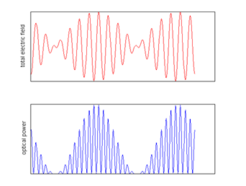
A photo-mixer is an optoelectronic device designed for optical heterodyning, i.e. for the generation of an electrical beat-note from the interference of two optical monochromatic signals (lasers) impinging on a DC-biased semiconductor material which absorbs the light. In the absorption process, electron-hole pairs are generated. These are separated by the electric field between two DC-biased electrodes, thereby creating a photo-current proportional to the optical intensity. The ultra-short electron lifetimes of the photo-mixer material, allowing the photo-current to ”follow” the envelope of the optical instantaneous power. This contains the laser difference frequency component. The photo-mixer feeds a planar antenna which is designed to optimally radiate the difference frequency component.

Implementation

Systematic studies were carried out by our group to establish a method to achieve best trade-offs between quantum efficiency, ultra-fast response times and device lifetime. Reproducible control over the concentration of ionized arsenic antisites, which act as electron ultrafast trapping centers in GaAs, is crucial to achieve these goals.

Scanning electron microscopy picture of a photo-mixer with dual-dipole antenna

Photo-mixer with dual-dipole antenna design @ 1.05 THz

Scanning electron microscopy picture of a photo-mixer with broadband antenna

Photo-mixer with broadband antenna

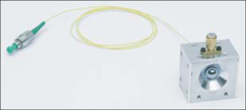
The photo-mixer metallization consists of small-area Ti/Au Metal-Semiconductor-Metal (MSM) structures feeding planar broad-band or resonant antennas. The metallization is patterned by standard electron-beam and optical lithography techniques. The external DC bias is applied to the MSM electrodes by electrically contacting the photo-mixer through bond pads. The optical coupling to the photo-mixer active area is realized by a single-mode fiber optic, positioned with submicron accuracy. Once the optimal illumination position has been achieved, the fiber is fixed to the photo-mixer. The (butt-coupled) photo-mixer and collimating lens are assembled in a compact housing, the assembly includes a fiber bend protection and a fiber patch with connector for the optical input.

A chip containing the photo-mixer and the antenna and is mounted on a high resistivity silicon substrate lens, which (i) collimates the radiation, (ii) prevents the signal from being radiated backwards to the fiber optics which illuminates the device, (iv) suppresses surface modes and (v) provides a high beam directivity. In order to minimize aberration, the maximum of the antenna pattern is aligned with the optical axis of the silicon lens.

Results

We have successfully pumped an astronomical SIS heterodyne receiver in the 1 THz range with room temperature operated photo-mixers:

Our phase-locking scheme enables relative stabilization of our free-running lasers, yielding a line width of 3 kHz only.

Go to Editor View